Showing posts with label Language. Show all posts

Wednesday, 12 January 2011

Rhyming dictionaries

There are several online rhyming dictionaries that can be helpful for practising pronunciation or creating short poems in the classroom.

Friday, 12 November 2010

English phonemic chart

Sounds Right is the British Council's first pronunciation chart for learners and teachers of English. Each phonetic symbol is supplemented with examples and audio.


Thursday, 16 September 2010

Measuring oral production

The Centre international d'études pédagogiques website includes short clips with language learners' oral productions in several languages which illustrate the different competency levels established by the Common European Framework of Reference for Languages.

Tuesday, 26 January 2010

Turtle, tortoise, or terrapin?

From Wikipedia:

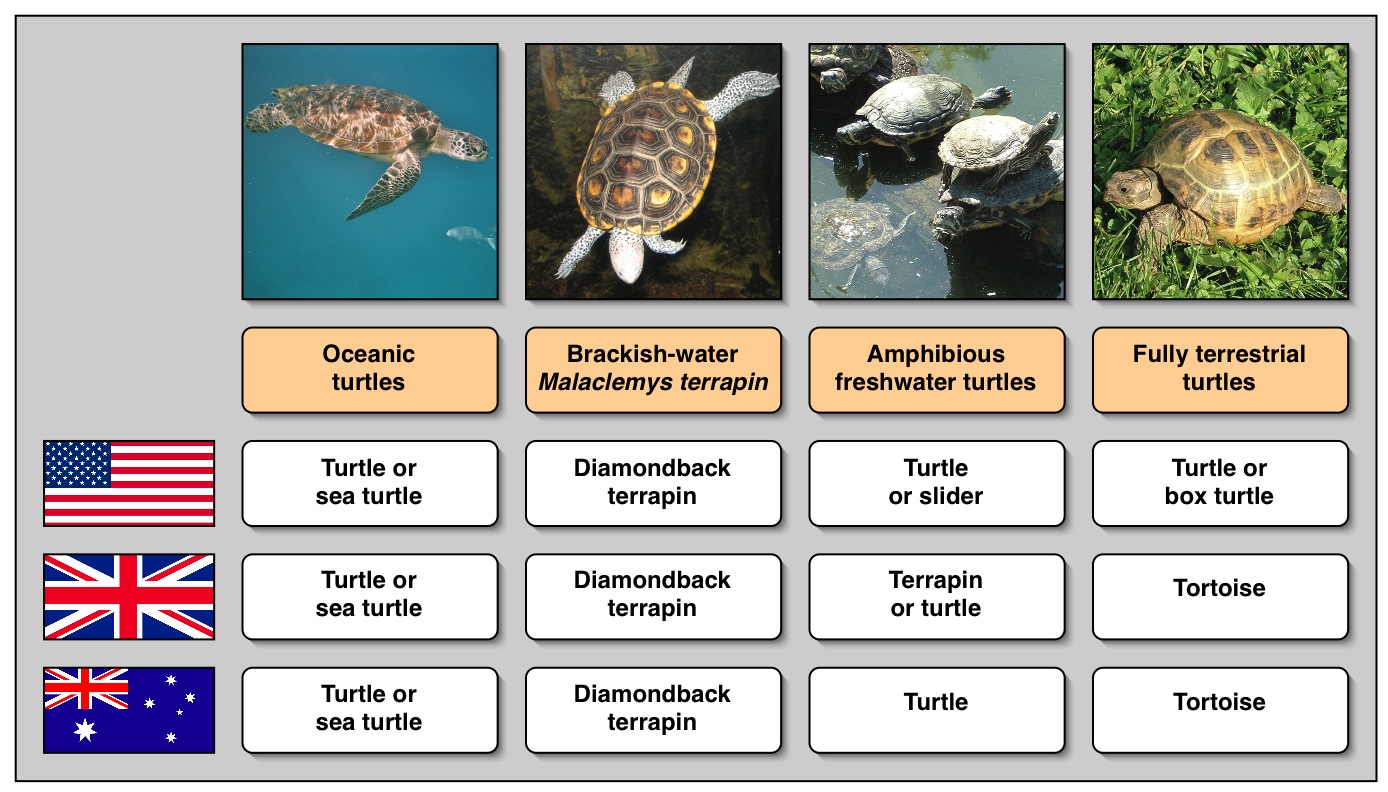
"Although the word turtle is widely used to describe all members of the order Testudines, it is also common to see certain members described as terrapins, tortoises or sea turtles as well. Precisely how these alternative names are used, if at all, depends on the type of English being used.

  • British English normally describes these reptiles as turtles if they live in the sea; terrapins if they live in fresh or brackish water; or tortoises if they live on land. However, there are exceptions to this where American or Australian common names are in wide use, as with the Fly River turtle.
  • American English tends to use the word turtle for all freshwater species, as well as for certain land-dwelling species (e.g. box turtles). Oceanic species are usually referred to as sea turtles, and tortoise is restricted to members of the true tortoise family, Testudinidae. The name terrapin is typically reserved only for the brackish water diamondback terrapin, Malaclemys terrapin; the word terrapin being derived from the Algonquian word for this animal.[11]
  • Australian English uses turtle for both the marine and freshwater species but tortoise for the terrestrial species."

Tuesday, 27 January 2009

Thursday, 15 January 2009

How to say 'espinillera' in English


Spanish: espinillera
Basque: zango-babes, berna-babes
English: Shin guard

Thursday, 18 December 2008

How to say 'velcro' in English?


Wikipedia provides a quite complete explanation on hook-and-loop fasteners , an everyday object that we usually refer to by its brand name.

This song presents an instance of use for 'velcro fastener'.

Wednesday, 13 February 2008

What is a 'literary text'?

A brief description of different senses of the term literature can be found in this Wikipedia entry (Spanish). A list of literary genres can be also accessed in the English version of Wikipedia.

Friday, 11 January 2008

Classroom language

You can access several documents on classroom language recently included by Anglès 365 in their website.

Monday, 10 December 2007

How to say 'mantala' in English?

It seems that 'smock' or 'school smock' could be appropriate terms for referring to the overalls used in many classrooms.

Smock: n. A loose coatlike outer garment, often worn to protect the clothes while working. (Answers.com)

Information on the history of school smocks


Little girl with school smock and carrying backpack with books.
Village: Volce.
Date: 1978 June

from http://www.library.umass.edu/spcoll/galleries/halpern78f.htm