
Wednesday, 13 March 2013
e-cultural Kaleidoscope

Tuesday, 12 March 2013
Power Point Games
A good number of resources aimed at developing academic vocabulary at school can be found from this link (type ppt in the search box). These materials include some blank templates of Power Point Games that can be completed by teachers of different levels and subject matter.

These are a couple of examples:
Holiday Squares is a version of Noughts and Crosses. It can be played with the whole class divided in two teams or in small groups of four (a pair of students make up a team), for instance. Older students could also generate their own games for the rest of the class.

Password game. A students stands on the front of the classroom with his or her back to the interactive board. The class gives the student clues to the vocabulary word on the screen as a clock keeps time. The student tries to guess the word before the buzzer sounds.

These are a couple of examples:
Holiday Squares is a version of Noughts and Crosses. It can be played with the whole class divided in two teams or in small groups of four (a pair of students make up a team), for instance. Older students could also generate their own games for the rest of the class.

Password game. A students stands on the front of the classroom with his or her back to the interactive board. The class gives the student clues to the vocabulary word on the screen as a clock keeps time. The student tries to guess the word before the buzzer sounds.

Saturday, 9 March 2013
GenMagic: online comic generator
GenMagic is a simple way to create short stories. The program allows users to choose from a set of background pictures, objects, animals, characters... and add text to the different six scenes. Once it is finished, the story can be printed out.


Friday, 8 March 2013
Word card generator
Abcteach web site includes a tool to create lists of word cards. The user can choose the topic, font, size and colour of the writing.
Thursday, 7 March 2013

Wednesday, 6 March 2013
Phonetics
These are several online resources that can be helpful to practise and improve pronunciation.
Ship or Sheep website displays some lists of words that focus on the differentiation of a particular sound by comparing minimal pairs.

Oxford University Press: New File.


Learn English Kids (British Council) also includes several resources to practise spelling and phonetic awareness.


Ship or Sheep website displays some lists of words that focus on the differentiation of a particular sound by comparing minimal pairs.
Oxford University Press: New File.
- This web page introduces the phonemic symbols of English by associating them to pictures that represent a word that contains a particular sound. Phonems and words can be listened to by dragging the mouse on the pictures.
- Stress monsters is a game aimed at identifying the stressed syllable in different words.
Learn English Kids (British Council) also includes several resources to practise spelling and phonetic awareness.
- Tricky words. This section contains matching activities and tests to practise spelling related to a particular phoneme.
Tuesday, 5 March 2013
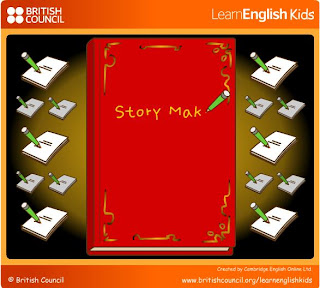
Story Maker
Story Maker is a simple activity that allows students to choose several items in a story. It makes three different types of story: fairy stories, horror stories and science-fiction.
Monday, 4 March 2013
Activities for Easter
These are some resources related to Easter and spring:
A story:
The Great Egg Hunt
Handicrafts:
How to Make a Spring Hat
Handouts:
Easter Worksheets

A story:
The Great Egg Hunt
Handicrafts:
How to Make a Spring Hat
Handouts:
Easter Worksheets

Monday, 11 February 2013
Make a monster
Make a monster is a simple game based on Leonardo Da Vinci's drawings. The aim is to create a monster by choosing its body parts from the models provided. The new pictures can be printed out or saved as pdf documents and can be used to practise description.

Example:

Example:
My monster has the head of a bird and the legs of a horse. It has the tail of a sea monster and two big wings. It has got two antlers and long pointed ears. It is always angry.
Thursday, 31 January 2013
The language of computers and the Internet in English
These are some glossaries and other type of resources that can turn out helpful to learn and practise the languages related to computer use.
About.com Spanish/English and Aprendiom offer bilingual lists of computing terms in English and Spanish.
Common computer terms in English is a monolingual glossary.
The British Council web site offers a song that includes some vocabulary related to computers: My Computer Mouse as well as some other activities on this topic.
The following video shows basic vocabulary on computers:
About.com Spanish/English and Aprendiom offer bilingual lists of computing terms in English and Spanish.
Common computer terms in English is a monolingual glossary.
The British Council web site offers a song that includes some vocabulary related to computers: My Computer Mouse as well as some other activities on this topic.
The following video shows basic vocabulary on computers:
Wednesday, 16 January 2013
From Rags to Riches
From Quia-Shared Activities web page we can access a good number of interactive activities created by teachers. Criteria for searching them include type of activity, subject or area of interest and levels. If we choose 'From Rag to Riches' and 'ESL-English as a second language' we can find games such as the following:
- 'a, an, or nothing'
- 'Apartments and furniture'
- 'To be: present tense'
- 'Family words'
- 'Where questions'

Templates and guidelines to create games based on 'Who wants to be a millionaire?" TV contest can be found here.
- 'a, an, or nothing'
- 'Apartments and furniture'
- 'To be: present tense'
- 'Family words'
- 'Where questions'

Templates and guidelines to create games based on 'Who wants to be a millionaire?" TV contest can be found here.
Tuesday, 15 January 2013
Creating photo stories

Time for a Photo Story: teacher guide
Time for a Photo Story: student materials
Subscribe to:
Posts (Atom)